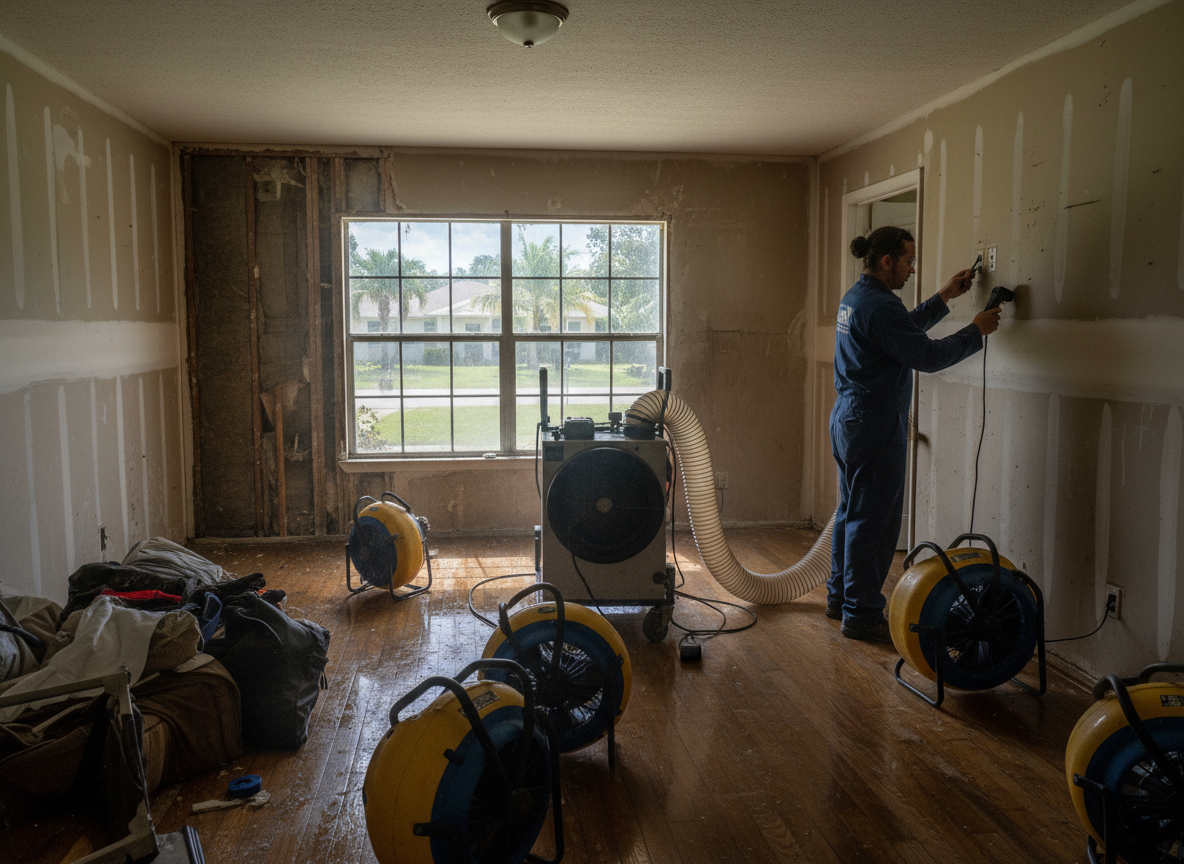
Englewood homes built before 1980 often have plaster walls and oak subfloors that trap water far longer than modern drywall. In Arapahoe County’s semi-arid climate, hot summer days can drive surface moisture out quickly while leaving deep cavities damp, creating hidden rot along joists near Belleview Park properties. Cold winter nights drop temperatures fast, slowing evaporation and forcing crews to adjust equipment run times in basements along South Broadway.
After extraction, we place commercial dehumidifiers and air movers in patterns that follow the actual airflow of each structure rather than a standard grid. Older homes near the Englewood City Center frequently have balloon framing that lets water travel vertically between floors, so we monitor moisture readings at multiple heights for several days. Failing to account for this movement leaves pockets that later cause cupping hardwood or blistering paint in Littleton and Cherry Hills Village referrals.
We also track indoor humidity against outdoor conditions because Denver’s dry air can mask elevated moisture content in concrete slabs common to Cushing Park ranch homes. Thermal imaging locates cool spots behind cabinets and under stairs that standard meters miss. Every job ends with documented readings below 12 percent moisture content on wood and 65 percent relative humidity before equipment is removed.
Technician insight
In Englewood the thing that catches most people out with structural drying is how fast the semi-arid air fools them into thinking a basement is dry while the north-facing walls near Cushing Park stay wet for weeks. Cold winter nights drop slab temperatures and force us to run equipment longer than jobs in Littleton or Denver.
Cushing Park Basement After Pipe Burst
Water from a burst supply line traveled under oak flooring and into plaster walls. We mapped moisture extending twelve feet along the north foundation, set dehumidifiers and air movers for five days, and confirmed all readings below target before removal. No mold developed and the homeowner avoided floor replacement.
Structural Drying Services We Offer
✓Moisture Mapping and Assessment
Pinpoint hidden water behind walls and under floors using meters and thermal cameras before drying begins.
✓Industrial Dehumidification Setup
Place high-capacity dehumidifiers sized for Arapahoe County home volumes to pull moisture from plaster and concrete.
✓Air Circulation and Ventilation
Position air movers to create directed airflow that reaches cavities in balloon-framed homes near Downtown Englewood.
✓Thermal Imaging Inspections
Scan for temperature differentials that reveal trapped water in subfloors and wall cavities after initial drying.
✓Basement Structural Drying
Target below-grade walls and slabs common in Cushing Park properties where cold winters slow natural evaporation.
✓Flooring and Subfloor Drying
Dry hardwood and plywood layers without removal when possible to prevent cupping in older Englewood homes.
Structural Drying Cost in Englewood, CO
| Service | Typical Range | What Affects It |
|---|---|---|
| Small room drying setup | $600–$1,200 | One or two rooms, 2–4 days equipment time |
| Whole floor structural drying | $1,800–$3,500 | Multiple rooms plus basement, 4–7 days |
| Basement slab and wall drying | $1,200–$2,800 | Concrete moisture, winter conditions extend time |
| Daily equipment rental extension | $150–$350 | Per day after initial package |
Ranges are typical for Englewood, CO and confirmed with an exact written quote before any work starts.
How it works
- 1
Initial Assessment
Measure moisture levels in walls, floors, and cavities using meters and thermal cameras on arrival.
- 2
Water Extraction
Remove standing water and saturated materials that can be safely discarded before drying equipment runs.
- 3
Equipment Placement
Set dehumidifiers and air movers in patterns matched to the home’s framing and airflow paths.
- 4
Daily Monitoring
Return each day to check readings, adjust equipment, and document progress until targets are met.
- 5
Final Verification
Confirm moisture content meets industry standards and remove equipment only after stable dry readings.
Pricing
Pricing depends on square footage affected, depth of water penetration, and number of days equipment must run.